





Victron Compatibility: Enhancing UK Off-Grid Power
Victron compatibility in the UK explained, covering supported products, Bluetooth monitoring, battery integration, and common mistakes to avoid.
Leaving the comforts of home for the British countryside does not mean sacrificing reliable power in your campervan. The challenge lies in creating an energy system where batteries, inverters, and solar panels communicate effortlessly. Victron compatibility is the backbone of a connected setup, transforming separate devices into a single energy ecosystem that offers real-time monitoring and intelligent management. Find out which solutions will keep your appliances running smoothly and help you stay independent off-grid.
Table of Contents
- Defining Victron Compatibility In Off-Grid Systems
- Victron-Compatible Product Types And Features
- Integrating Lithium Batteries With Victron Devices
- Bluetooth Monitoring And System Setup Essentials
- Common Pitfalls And How To Avoid Them
Key Takeaways
| Point | Details |
|---|---|
| Importance of Victron Compatibility | Ensures seamless communication between batteries, inverters, and solar controllers for optimal energy management in campervans. |
| Real-Time Monitoring Benefits | Provides immediate visibility into battery levels and charging status, enabling proactive management of energy use. |
| Integration and Expandability | Victron-compatible systems allow for easy upgrades and additions without needing to replace existing components. |
| Choosing Compatible Components | Verify communication standards (VE.Can, VE.Direct, Bluetooth) to prevent costly integration issues prior to purchase. |
Defining Victron Compatibility in Off-Grid Systems
Victron compatibility refers to a system’s ability to work seamlessly with Victron Energy equipment—the market-leading brand for off-grid monitoring and power management in Europe. For campervan owners, this compatibility means your battery, inverter, solar controller, and monitoring devices can communicate intelligently with each other, rather than operating in isolation.
At its core, Victron compatibility ensures components speak the same language. Your lithium battery management system sends real-time data to a Victron inverter, which adjusts power distribution based on your actual energy use. The solar controller monitors incoming solar power and communicates charging priorities. This interconnected approach transforms a collection of parts into a cohesive energy ecosystem.
Why Compatibility Matters for Campervan Living
When systems are compatible, several practical advantages emerge:
- Real-time monitoring shows battery state, voltage, and charging status via app or display
- Intelligent load management automatically reduces power-hungry devices when batteries run low
- Efficient charging optimises how solar panels, hook-up chargers, and alternators top up your batteries
- System longevity prevents overcharging and deep discharges that damage batteries
- Troubleshooting clarity identifies problems quickly through diagnostic data
Without compatibility, you’re flying blind. Your lithium battery has no way to tell your inverter how much power is actually available, so it might cut out unexpectedly or run inefficiently.
Victron-compatible systems transform guesswork into precision, giving you confidence in your power supply during weeks off-grid.
The Technical Foundation
Victron compatibility operates through established communication protocols. Most modern Victron equipment uses VE.Can (a vehicle-area network) or VE.Direct (a serial communication standard) to share data between devices. Some newer components also support Bluetooth, which is particularly useful in campervans where running cables becomes complicated.
When you choose Victron-compatible systems for your campervan setup, you’re ensuring that your lithium batteries, solar charge controllers, inverters, and battery monitors all understand each other’s language. This standardisation eliminates compatibility headaches.
The beauty lies in expandability. Start with a basic setup—battery, inverter, and solar panel—then add monitoring or additional chargers later without replacing existing components. Everything integrates because they’re all speaking Victron.
Here’s a quick comparison of Victron-compatible communication protocols and their campervan integration benefits:
| Protocol | Typical Devices | Integration Complexity | Campervan Benefit |
|---|---|---|---|
| VE.Can | Inverters, BMS, Solar | Medium | Enables advanced automation |
| VE.Direct | Monitors, Controllers | Low | Simple device pairing |
| Bluetooth | Monitors, Inverters | Very Low | Wireless, easy monitoring |
| CAN Bus | Lithium Batteries, GX | High | Real-time diagnostics |
What Makes a Component “Victron Compatible”
A device earns Victron compatibility through two pathways. First, it’s manufactured by Victron Energy itself, guaranteeing full integration. Second, third-party manufacturers design their products to work with Victron’s open standards, allowing batteries and chargers from other brands to communicate via Victron monitoring systems.
This matters because you don’t need every component branded Victron. Your lithium battery might come from one supplier and your solar controller from another—both can be Victron-compatible, creating a unified system under Victron’s intelligent management platform.
Pro tip: Before purchasing any new off-grid component, verify it supports either VE.Can, VE.Direct, or Bluetooth communication with Victron equipment. This single check prevents costly incompatibility issues down the road.
Victron-Compatible Product Types and Features
Victron’s product ecosystem covers every major component in an off-grid system. Understanding what each type does helps you build a setup that matches your campervan’s actual power needs, rather than buying randomly and hoping components work together.
The main categories include inverters, battery monitors, solar charge controllers, DC/DC converters, and multi-functional devices that combine several functions into one unit. Each serves a specific role, but they all communicate through Victron’s standardised protocols.
To assist your system design, here is a summary of Victron-compatible product types and their practical role:
| Product Type | Primary Function | Campervan Application |
|---|---|---|
| Inverter | DC to AC power conversion | Power for household appliances |
| Battery Monitor | Energy usage tracking | Prevents battery depletion |
| Solar Charge Controller | Regulates solar charging | Maximises solar energy |
| DC/DC Converter | Alternator to battery charge | Safe vehicle battery integration |
| Multi-Functional Device | Combined system management | Simplifies wiring and setup |
Inverters
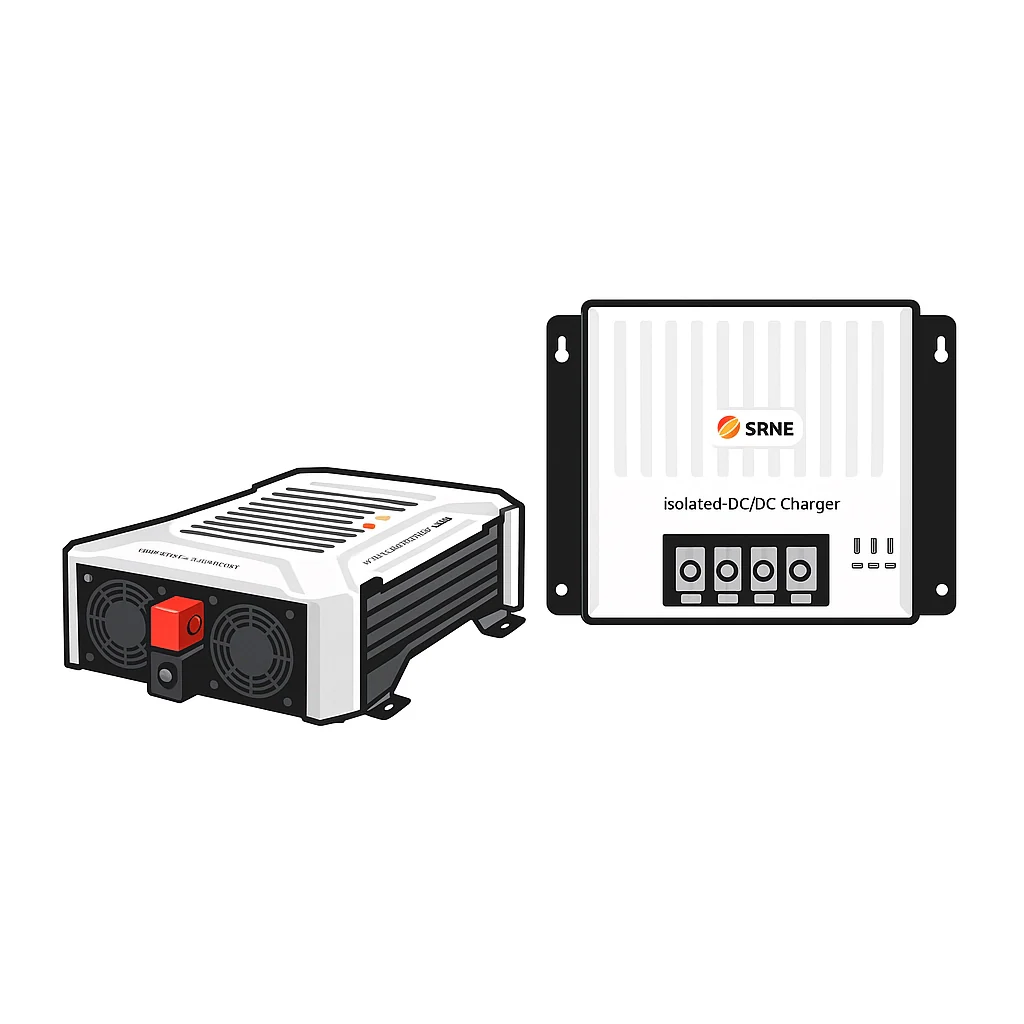
An inverter converts your stored DC power (from batteries) into AC power for standard UK appliances like kettles, laptops, and televisions. Victron inverters are built to handle the unique demands of campervan living—sudden power spikes when devices switch on, and extended periods running from batteries alone.

Multi-functional inverters like the Victron MultiPlus Compact range combine inverting, battery charging, and AC input switching into one intelligent unit. When you’re hooked up to shore power, it charges your batteries. When you’re off-grid, it powers your appliances from batteries. The transition happens seamlessly.
Key features to consider:
- Pure sine wave output means your sensitive electronics stay protected
- Multiple input sources prioritise shore power, then alternator, then solar
- Remote on/off capability via monitoring app or physical switch
- Customisable charging profiles adapt to your battery chemistry
Battery Monitors
A battery monitor is your campervan’s fuel gauge for energy. It tracks state of charge, voltage, current draw, and time remaining—all displayed on a screen or smartphone app.
Victron’s BMV series monitors provide real-time visibility into what’s happening with your batteries. Without one, you’re guessing whether you can run the kettle or risk draining batteries below safe levels. With one, you know exactly how much power you’ve used and how much capacity remains.
A quality battery monitor transforms your energy awareness from guesswork into precision data.
Solar Charge Controllers
A solar charge controller manages power flowing from your roof panels into your batteries. It prevents overcharging, optimises the charging process, and communicates solar input status to other system components.
Victron’s MPPT (Maximum Power Point Tracking) controllers automatically adjust voltage and current to extract maximum power from solar panels throughout the day, even during partial cloud cover. This means your panels generate 20-30% more usable energy than basic controllers.
Controllers offer:
- MPPT technology maximises solar harvesting efficiency
- Multi-stage charging balances speed with battery health
- Temperature compensation adjusts charging based on battery temperature
- VE.Can communication shares solar input data across your system
DC/DC Converters
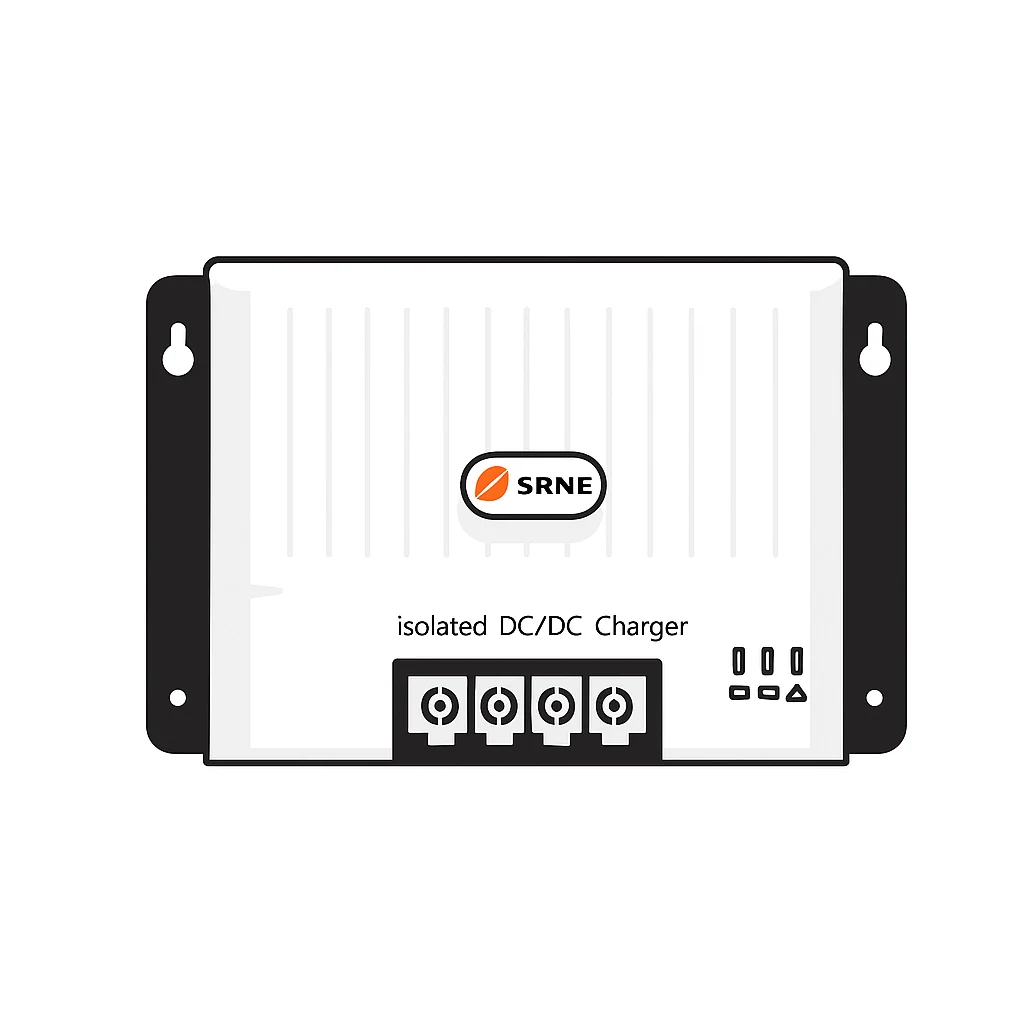
A DC/DC converter safely charges your leisure battery from your vehicle’s alternator whilst driving. Direct connection to the alternator would overcharge your lithium batteries in seconds.
Victron Orion converters manage this conversion intelligently, protecting batteries whilst accepting high current from the alternator. They integrate with your monitoring system, so you see alternator charging in your app alongside solar and shore power contributions.
Multi-Functional Devices
Some devices combine multiple functions—inverting, charging, and system switching—into single units that save space and wiring complexity. These are particularly useful in campervans where every cubic centimetre matters.
Pro tip: Start by identifying your three core needs: inverter capacity (in watts), battery capacity (in amp-hours), and power sources (solar, alternator, shore power). Then select compatible components that address those specific needs rather than buying products individually and hoping they integrate.
Integrating Lithium Batteries With Victron Devices
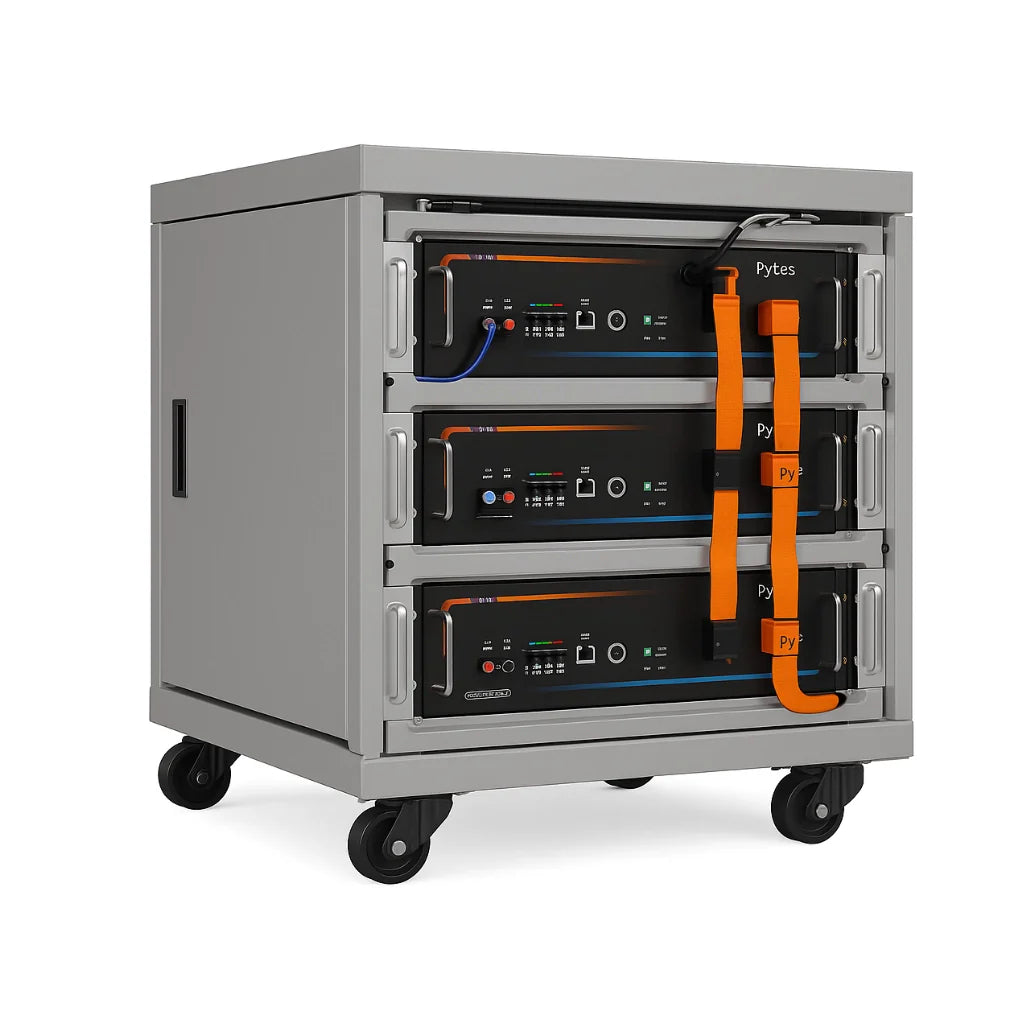
Lithium batteries and Victron equipment form a natural partnership. Lithium chemistry requires intelligent charging management—exactly what Victron systems provide—whilst Victron monitoring relies on battery feedback to function optimally. Getting this integration right means your batteries stay healthy for years rather than degrading through overcharge or deep discharge.
The key is ensuring your lithium battery communicates with Victron components using supported protocols. Without proper integration, your expensive lithium investment operates without protection, like driving without insurance.
Battery Management System Communication
Every quality lithium battery includes a Battery Management System (BMS) that monitors individual cells, balances charge, and prevents damage. For Victron integration, your battery’s BMS must support VE.Can or VE.Direct communication.
When properly connected, your battery tells the Victron inverter exactly how much power is available, its current temperature, and its state of health. The inverter responds by adjusting charging behaviour. This real-time conversation prevents the dangerous scenario where an inverter demands more power than the battery can safely deliver.
Lithium batteries without intelligent communication with Victron devices operate in isolation, sacrificing safety and lifespan.
Choosing Compatible Lithium Batteries
Not every lithium battery works well with Victron systems. Look for batteries that explicitly support VE.Can or VE.Direct protocols. Many aftermarket lithium options lack this compatibility, leaving you unable to integrate properly.
When selecting batteries, verify:
- BMS communication protocol matches your Victron setup (VE.Can, VE.Direct, or Bluetooth)
- Voltage compatibility aligns with your inverter (12V, 24V, or 48V systems)
- Current rating matches your expected power draw without causing the BMS to shut down under load
- Warranty coverage includes integration with specific Victron models
Skipping this verification step leads to frustrating compatibility issues after installation.
CAN Bus Communication Benefits
CAN bus (Controller Area Network) represents the most sophisticated communication standard for lithium-Victron integration. Using CAN bus communications with Victron systems enables advanced features like dynamic load shedding, predictive charging, and detailed diagnostics.
With CAN bus, your Victron system knows exactly what your battery can tolerate, adjusting inverter output in real time. This prevents the abrupt shutdowns that occur when a battery’s BMS suddenly disconnects due to overload.
Configuration Steps
Integration requires proper configuration rather than simply plugging cables together:
- Connect the communication cable between battery BMS and Victron device (VE.Can, VE.Direct, or Bluetooth depending on your setup)
- Update firmware on all devices to the latest versions supporting your battery model
- Configure battery parameters in your Victron inverter—voltage limits, charge rates, and chemistry-specific settings
- Test communication via the Victron app or display to confirm data is flowing
- Monitor initial charging cycles to ensure the battery and inverter are working together correctly
Missing any of these steps risks your system operating blindly.
Pro tip: Before purchasing a lithium battery, contact Victron directly or check their compatibility database to confirm integration support for your specific inverter model—this prevents costly incompatibility after installation.
Bluetooth Monitoring and System Setup Essentials
Bluetooth connectivity transforms your Victron system from a black box into transparent, accessible data. Instead of walking to your campervan’s battery compartment to check voltage, you monitor everything from your phone whilst sitting in your living space. This convenience matters more than it sounds when you’re trying to manage power during a cold winter week off-grid.
Victron’s Bluetooth integration works with dedicated monitors, inverters, and battery management systems that include wireless capability. Setting it up correctly ensures you get reliable readings without dropped connections or laggy updates.
Why Bluetooth Monitoring Matters
Real-time monitoring prevents disasters. You see immediately when batteries drop below safe levels, when solar panels are generating power, and when your alternator is charging. This visibility lets you make informed decisions about appliance usage before problems develop.
Bluetooth avoids the cable clutter that plagues engine bays and battery compartments. In a campervan where space is precious, wireless monitoring simplifies installation and reduces troubleshooting points.
Key advantages include:
- Instant visibility of battery state of charge, voltage, and current draw
- Alert notifications when batteries reach critical levels or temperatures spike
- Historical data tracking to understand your consumption patterns
- Remote access to key metrics without opening compartments
- Cable-free installation reducing wiring complexity
Selecting Bluetooth-Enabled Victron Components
Not every Victron device includes Bluetooth. Check product specifications before purchasing—Bluetooth capability adds cost but delivers proportional convenience benefits in campervan applications.
Common Bluetooth-enabled Victron products include battery monitors (BMV series), multi-functional inverters (MultiPlus models with Bluetooth), and solar controllers (MPPT models with Bluetooth connectivity). Verify your specific model includes this feature before installation.
Mixed systems work too. You might have a Bluetooth-enabled battery monitor communicating with a traditional wired inverter. The key is ensuring at least your critical components provide wireless data.
Bluetooth monitoring transforms energy management from reactive troubleshooting into proactive power planning.
Installation Essentials
Proper Bluetooth setup requires careful attention to placement and configuration:
- Position the Bluetooth device with clear line-of-sight from your living space—metal barriers weaken signal strength significantly
- Download the Victron Connect app on your smartphone before installation
- Pair the device by scanning the QR code on the product (faster and more secure than manual entry)
- Configure system parameters including battery chemistry, inverter capacity, and warning thresholds
- Test notifications to confirm you receive alerts at critical battery levels
Common Bluetooth Setup Mistakes
Avoiding these errors saves frustrating troubleshooting later:
- Installing Bluetooth devices deep inside metal battery boxes where signal cannot penetrate
- Forgetting to update the Victron Connect app, missing compatibility with newer devices
- Setting unrealistic warning thresholds that trigger false alarms constantly
- Failing to configure battery chemistry parameters, leading to inaccurate state-of-charge readings
Data Security Considerations
Victron Bluetooth uses encryption to prevent unauthorised access to your system. However, you control who can pair devices by managing app access on your phone. Change default passwords if your system includes administrative functions.
Public WiFi networks pose no direct risk because Bluetooth operates independently of internet connectivity. Your monitoring data stays local between your phone and your campervan’s equipment.
Pro tip: Position your Bluetooth monitor or inverter on an upper shelf or cabinet rather than tucked away behind batteries—better signal strength means faster updates and fewer dropped connections during your time off-grid.
Common Pitfalls and How to Avoid Them
Building a Victron-compatible system seems straightforward until something goes wrong. Most problems stem from skipped steps during setup or mismatched component expectations. Learning what catches people out helps you navigate the process confidently without expensive mistakes.
The good news: virtually every pitfall is preventable with proper planning and verification before installation. Rushing costs far more than taking time upfront.
Mixing Communication Standards
The most common error is combining devices that speak different languages. You cannot simply connect a VE.Direct device to a VE.Can network, or assume Bluetooth will work when the battery uses wired communication.
Before purchasing anything, verify every component uses compatible communication protocols. A single mismatched device means incomplete system integration and wasted money.
Prevent this by:
- Mapping your entire system architecture before buying any components
- Documenting communication requirements for each device (VE.Can, VE.Direct, Bluetooth, or wired)
- Cross-checking compatibility on the Victron website compatibility matrix
- Contacting manufacturers if you’re uncertain about specific models
Undersizing Battery Capacity
Campervans owners frequently underestimate daily power consumption. You calculate that a 100Ah battery seems reasonable, then discover within days that you’re draining it completely by evening.
Undersizing forces you into constant charging anxiety and rapidly damages lithium batteries through excessive cycling. You end up spending more money on a larger replacement system than you would have spent initially.
Properly sizing your battery capacity prevents the frustration of daily energy rationing and protects your equipment investment.
Incorrect Inverter Capacity Selection
An inverter rated for 2000W might fail to start your 1500W kettle if you don’t account for inrush current—the brief surge when devices initially switch on. Many devices pull two to three times their running power during startup.
Select inverters with at least 30% headroom above your simultaneous peak load. This prevents automatic shutdowns during normal appliance use.
Poor Cable Management and Grounding
Wiring Victron systems incorrectly creates voltage drops, signal interference, and dangerous electrical faults. Using undersized cables, mixing communication lines with power cables, or skipping proper grounding causes intermittent failures that are nightmarish to diagnose.
Follow manufacturer specifications precisely:
- Power cables sized for expected current draw (never improvise with undersized wire)
- Communication cables run separately from high-current power lines
- Grounding points bonded directly to battery negative terminals
- Cable shielding protecting VE.Can and VE.Direct lines from interference
Neglecting Firmware Updates
Victron releases firmware updates that add device compatibility, fix bugs, and improve performance. Operating outdated firmware might prevent your new lithium battery from communicating with your existing inverter.
Update all devices to current firmware before installation. Check for updates quarterly after setup to maintain compatibility with new components you might add later.
Skipping Configuration Steps
Plugging devices together without configuring parameters leaves your system operating with default settings that may not match your battery chemistry or expected usage patterns. This causes inefficient charging and inaccurate state-of-charge readings.
Take time to configure:
- Battery chemistry (lithium, lead-acid, or specific lithium variant)
- Voltage and current limits matching your battery specifications
- Warning thresholds for low battery alerts
- Charging profiles suited to your actual power sources
This investment of an hour saves months of frustration.
Pro tip: Create a detailed spreadsheet documenting your complete system before purchasing anything—list every component, its communication protocol, power ratings, and compatibility requirements. This single document prevents 90% of integration mistakes.
Master Your Off-Grid Power with Skyenergi’s Victron-Compatible Solutions
Victron compatibility is essential for transforming disconnected energy parts into a smart, cohesive off-grid system. If you want to avoid the common pitfalls of mismatched communication protocols and inefficient battery management, Skyenergi offers tailored solutions that embrace the very principles discussed in the article. Whether you need lithium batteries with intelligent Battery Management Systems, solar charge controllers, or fully Victron-compatible setups, our products deliver reliable performance with seamless integration. Experience real-time Bluetooth monitoring and expandability designed specifically for UK campervan owners and off-grid enthusiasts.
Don’t settle for guesswork in your power system. Visit Skyenergi today to build a Victron-compatible energy system that protects your investment and powers your adventures confidently. Explore our range of Victron-compatible components and take the first step towards smarter, safer energy independence now.
Frequently Asked Questions
What is Victron compatibility in off-grid systems?
Victron compatibility refers to the ability of various off-grid components, such as batteries, inverters, and solar controllers, to work seamlessly with Victron Energy equipment. This compatibility allows for intelligent communication and management of power within an off-grid system.
Why is it important to have compatible systems in a campervan?
Having compatible systems in a campervan enables real-time monitoring of battery status, intelligent load management, efficient charging, and enhances the longevity of the components. It prevents issues like overcharging and helps identify problems quickly through diagnostic data.
How can I ensure my lithium batteries integrate well with Victron devices?
To ensure proper integration, verify that your lithium battery supports communication protocols such as VE.Can or VE.Direct. This allows the battery management system to communicate effectively with Victron components, ensuring safe and efficient operation.
What are the different communication protocols used by Victron products?
Victron products typically use communication protocols such as VE.Can, VE.Direct, and Bluetooth. These protocols allow devices to share data and work together efficiently, leading to a cohesive and well-managed energy system.
Recommended
- Victron Compatible Systems – Powering Off-Grid Living – Skyenergi
- Victron MultiPlus 12/3000/120-50 120V VE.Bus PMP123021102 – Skyenergi
- Off-Grid Power Systems: Enhancing Energy Freedom – Skyenergi
- Victron Energy MultiPlus-II 48/5000 48V 5000VA – PMP482505012 – Skyenergi
- Comment atteindre l’autonomie énergétique avec le solaire ?
Prev post

Top 6 Best Lithium Leisure Batteries 2025 for UK Adventurers
Updated on 22 February 2026
Next post

Energy Storage Installation Process for Campervans UK
Updated on 20 February 2026


